Rash That Spreads: Causes, How to Track It, and When to Worry
Medically Reviewed By
Dr. Marcus Chen, FAAD
Last Updated
December 16, 2025
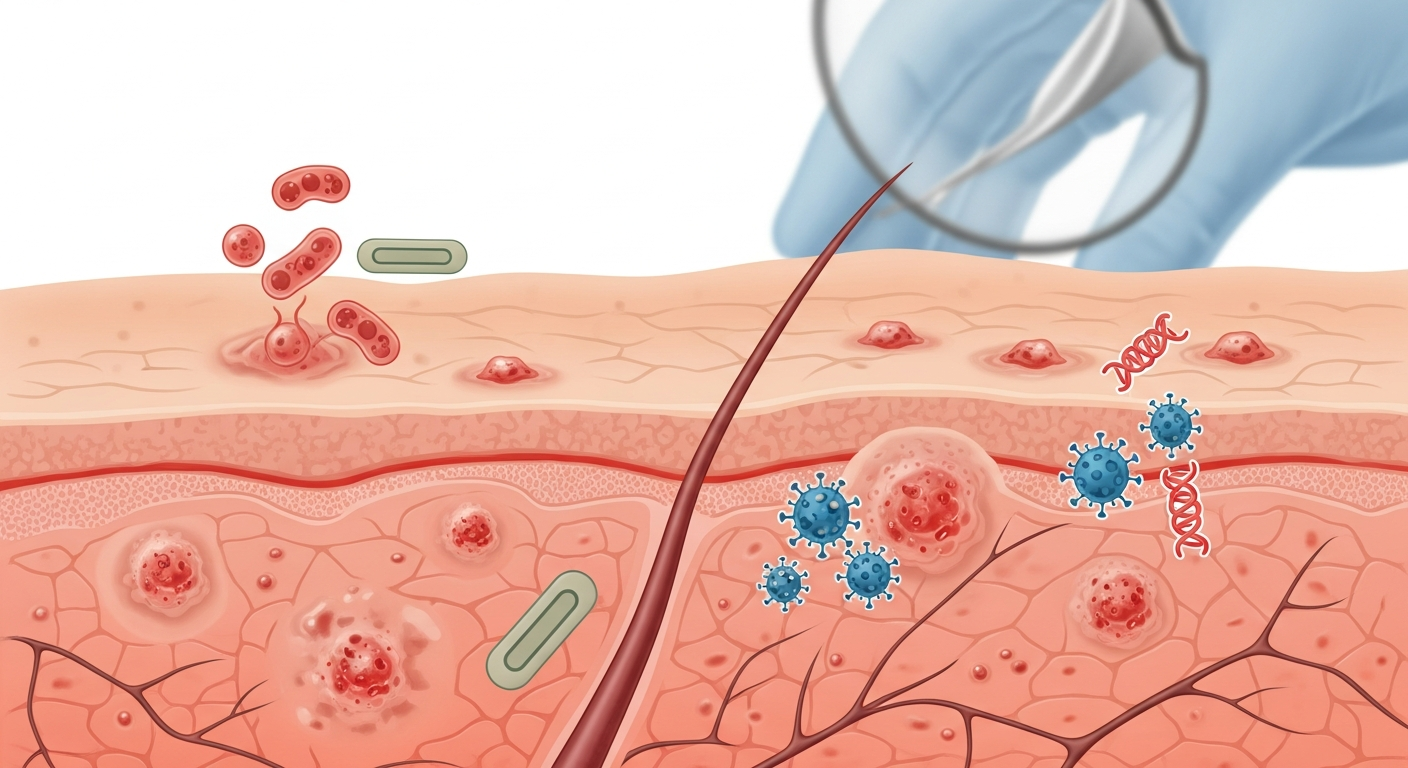
A spreading rash commands attention — the rate, direction, and nature of spread are among the most diagnostically valuable features in dermatology. However, 'spreading rash' encompasses a huge range of mechanisms: a cellulitis infection spreading outward from a skin break due to advancing bacterial invasion; a drug rash beginning on the trunk and spreading symmetrically to the limbs as the drug continues to circulate; ringworm growing slowly in an expanding ring; allergic contact dermatitis appearing delayed and expanding as more skin becomes exposed to the allergen; or a viral exanthem spreading from central to peripheral distribution as the viral illness evolves. Each of these has a different mechanism, urgency, and treatment. Understanding the rate and character of spread — combined with the location, morphology, and associated symptoms — allows a systematic approach to distinguishing the urgent from the benign. This guide covers the major causes of spreading rash, how to monitor and document spread, which presentations warrant emergency care, and evidence-based management for each cause.
Quick Medical Summary
Causes of Spreading Rash: From Benign to Emergent
Cellulitis is the most medically important cause of a rapidly spreading skin rash. A bacterial skin infection — typically Staphylococcus aureus or Streptococcus pyogenes entering through a cut, abrasion, insect bite, or skin break from athlete's foot — spreads as the bacteria advance through the subcutaneous tissue, producing a continuously expanding area of redness, warmth, swelling, and tenderness on the lower leg, hand, or face. The expansion is continuous hour by hour. Mark the border with a pen at presentation: if the redness extends beyond this mark within 12–24 hours, the spread is clinically significant and confirms active cellulitis progression. Drug rash (morbilliform drug eruption) is the second most common cause of spreading rash in adults — beginning as discrete pink spots on the trunk 7–14 days after starting a causative medication (antibiotics, NSAIDs, anticonvulsants, allopurinol), then spreading symmetrically to involve the arms, legs, and face over 2–5 days as the drug continues to be taken. The spread stops when the drug is discontinued. Allergic contact dermatitis can appear to spread even after the allergen is removed, because: (1) the immune reaction is delayed 24–72 hours and involves skin areas that were lightly exposed but had insufficient antigen to trigger the reaction initially; and (2) autosensitization — the skin can become generalized sensitized after severe localized reactions, producing secondary spread. Ringworm (tinea corporis) is a slowly spreading ring — the advancing scaly border moves outward by a few millimeters per day while the center clears. This slow, centrifugal, ring-shaped spread is pathognomonic. Viral exanthems spread from central (trunk) to peripheral (arms, legs, face) over 1–3 days as the viremia (virus in the bloodstream) distributes — this is bidirectional spread from the trunk outward, not from a single source point. Impetigo spreads by direct contact — new satellite lesions appear at sites of autoinoculation (where the patient scratches the primary lesion and then touches another area).
How to Track and Describe a Spreading Rash
Systematic documentation of a spreading rash significantly helps medical assessment. The following approach is used by clinicians and can be done at home to provide invaluable information for the treating doctor. For cellulitis and other locally advancing rashes: use a ballpoint pen or skin marker to draw a line around the outer border of the rash at the time of first presentation. Write the time and date next to the line. Take a photograph. Return to check in 12 hours — if the redness extends clearly beyond the marker line, this confirms active progression and increases the urgency of evaluation. For spreading drug rash: document the date the medication was started, the date the rash appeared, the initial location (usually trunk), the current extent (which body areas are now involved), and any associated systemic symptoms (fever, lymph node tenderness, facial swelling, liver tenderness). For ringworm: measure the diameter of the ring on day 1, 7, and 14 — the slow outward expansion and central clearing confirm the diagnosis. For other spreading rashes: use a body diagram to shade affected areas; take daily photographs in consistent lighting from the same distance; note any change in character (rash becoming blistering, purpuric, or swollen) alongside geographic spread. Additional tracking questions: Is the spread rapid (hours, as in cellulitis, anaphylaxis, SJS) or slow (days to weeks, as in ringworm, contact dermatitis, psoriasis extending to new plaques)? Does spread correlate with a continuing exposure (drug still being taken, allergen still in contact) or is it progressing despite removal of the trigger (bacterial infection spreading despite antibiotic start — evaluate for resistant organism)? Is the spread bilateral and symmetric (drug reaction, viral exanthem) or unilateral from a focus point (cellulitis, ringworm, herpes zoster)?
When a Spreading Rash Is a Medical Emergency
Not all spreading rashes are emergencies, but specific patterns demand immediate action. Rapidly spreading redness, warmth, swelling, and pain from a wound, skin break, or insect bite — particularly with fever and systemic unwellness — is cellulitis that may progress to septicemia. In the most severe cases, the extreme pain is disproportionate to the surface appearance, crepitus (crackling under the skin) may be felt, and the patient is systemically toxic: this is necrotizing fasciitis, a surgical emergency with high mortality. Call emergency services. Non-blanching rash spreading in hours with fever, headache, and neck stiffness: meningococcal septicemia — emergency. Red streaking spreading from a wound upward along a limb toward the armpit or groin (lymphangitis): bacterial spread through the lymphatic system — call a doctor or go to the emergency department immediately. Do not wait. Spreading blistering rash involving lips, mouth, and eyes, developing within 7–14 days of starting a new medication: Stevens-Johnson Syndrome — stop all suspect medications and go to the emergency department. Spreading urticaria with throat tightening or breathing difficulty: anaphylaxis — epinephrine auto-injector and call emergency services. A drug rash that was initially maculopapular and now shows blistering, facial oedema, lymph node enlargement, or systemic symptoms: possible DRESS syndrome progression — medical emergency. Spreading impetigo in a young child with fever and widespread skin detachment (Nikolsky sign positive): staphylococcal scalded skin syndrome — requires hospitalization and IV antibiotics. Most other spreading rashes — including viral exanthems, contact dermatitis, drug rashes without systemic features, and ringworm — can be safely evaluated in a GP appointment within 1–3 days, not in an emergency department.
Key Symptoms
- Expanding warmth, redness, and tenderness from a wound with fever (cellulitis)
- Red streaking from a wound toward the armpit or groin (lymphangitis — urgent)
- Trunk rash spreading symmetrically to arms, legs with medication history (drug rash)
- Slowly expanding ring with advancing scaly border, central clearing (ringworm)
- Central trunk rash spreading outward with fever (viral exanthem)
- Satellite lesions appearing at sites of scratching (spreading impetigo)
- Spreading blistering with mucosal involvement after new drug (SJS — emergency)
- Non-blanching purpura spreading rapidly with fever (meningococcal — emergency)
Treatment Options
- Cellulitis: mark border; oral flucloxacillin or cephalexin; IV if spreading past mark
- Lymphangitis: emergency evaluation; IV antibiotics
- Drug rash: stop causative drug; monitor for DRESS progression; antihistamines
- Ringworm: topical terbinafine or clotrimazole for 4 weeks — full course essential
- Viral exanthem: supportive — antipyretics, fluids, rest; self-limiting
- Impetigo: topical mupirocin or oral antibiotics; strict hygiene to prevent spread
- Allergic contact dermatitis: remove allergen; oral prednisolone for severe spread
- SJS: stop all drugs; emergency hospitalization; burns unit care
| Condition | Speed of Spread | Pattern | Urgency |
|---|---|---|---|
| Cellulitis | Hours — continuous | From wound outward; unilateral | Urgent same-day — antibiotics |
| Necrotizing Fasciitis | Minutes to hours | Rapid; extreme pain; crepitus | Emergency — surgery now |
| Meningococcal | Hours | Anywhere; non-blanching | Emergency — 999/911 |
| Drug Rash (morbilliform) | Days | Trunk → limbs; bilateral symmetric | Stop drug; GP evaluation |
| Ringworm | Days to weeks | Expanding ring; centrifugal | GP within days; topical antifungal |
| Viral Exanthem | 1–3 days | Trunk → periphery; bilateral | Supportive; GP if uncertain |
Narrow Down Your Diagnosis Further
When to See a Doctor Immediately
- Difficulty breathing or swallowing
- Swelling of the face, lips, or tongue
- High fever or severe chills
- Rapid spreading over a large body surface area
- Extreme pain, dizziness, or confusion
Frequently Asked Questions
Disclaimer
The medical information provided in this article is for educational purposes only and should not replace professional medical advice, diagnosis, or treatment. Always consult with a board-certified dermatologist or primary care physician regarding any severe or persistent skin conditions.