Non-Itchy Rash: Causes, Identification, and What It Might Mean
Medically Reviewed By
Dr. Marcus Chen, FAAD
Last Updated
November 8, 2025
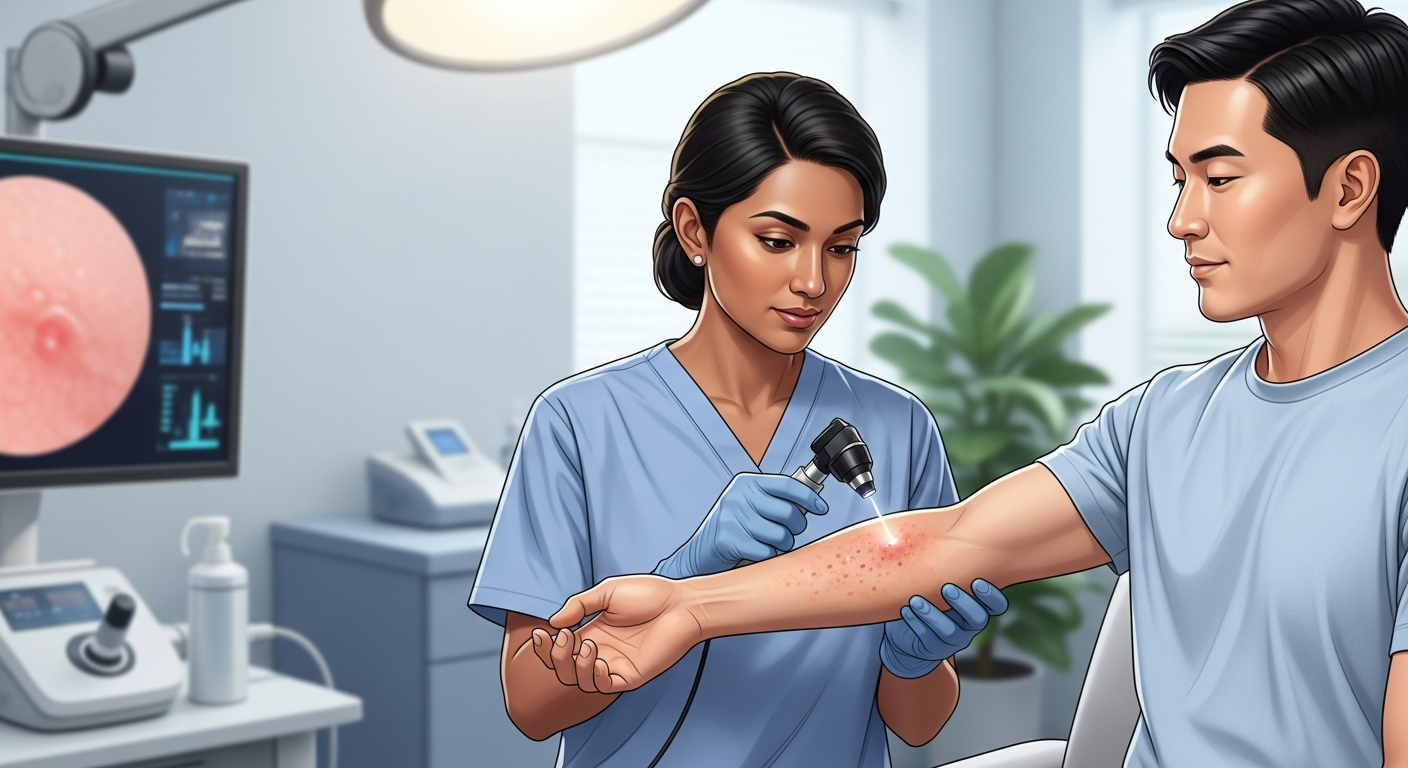
A rash without itch is frequently underreported, dismissed by patients, or attributed to minor trauma — and this is clinically dangerous, because several of the most diagnostically important and medically serious rashes are characteristically non-itchy. Erythema migrans — the expanding red ring of Lyme disease — is classically painless and non-itchy, which is precisely why it is so often missed or ignored. The secondary rash of syphilis on the palms and soles is non-itchy, widespread, and appears when the patient may be feeling systemically well — which is why untreated syphilis continues to progress unseen. Purpura (non-blanching red-brown spots) from vasculitis or meningococcal disease is non-itchy, which means a patient may look at it and think it is just bruising, missing the life-threatening diagnosis. On the other hand, many non-itchy rashes are completely benign: tinea versicolor (pigmentation change from yeast overgrowth) is non-itchy and merely cosmetic; pityriasis rosea is mildly or non-itchy and self-limiting; milia and sebaceous cysts are non-itchy and benign. The key diagnostic skill with non-itchy rash is the blanching test combined with a detailed history of recent illness, travel, medications, and sexual contacts.
Quick Medical Summary
Possible Causes of Non-Itchy Rash: Ranked by Clinical Importance
Erythema migrans (Lyme disease) is arguably the most clinically important non-itchy rash to identify. It appears 3–30 days after a tick bite from Ixodes ticks in endemic areas (northeastern USA, parts of Europe and Asia), as an expanding oval or round red patch that may develop a characteristic bull's-eye appearance — a central clearing area surrounded by a ring of redness. It grows steadily outward and is typically non-itchy and non-painful. Antibiotic treatment (doxycycline 100mg twice daily for 10–21 days) must begin early, before Lyme disease progresses to neurological, cardiac, and joint involvement. The secondary rash of syphilis (Treponema pallidum, stage 2) appears 6–8 weeks after the primary chancre resolves, as a widespread, non-itchy, copper-colored, maculopapular rash characteristically involving the palms and soles — the combination of a non-itchy, non-blistering rash on the palms and soles in a sexually active adult is syphilis until proven otherwise. Associated systemic symptoms include fever, malaise, lymph node enlargement, and oral mucous patches. Requires immediate STI clinic evaluation and penicillin treatment. Psoriasis plaques can be mildly itchy or entirely non-itchy — particularly plaque psoriasis on the elbows, knees, and scalp. Many patients report their psoriasis as 'not itchy' before dermatological evaluation. Purpura — non-blanching red, purple, or brown spots — from any cause (vasculitis, meningococcal, thrombocytopenia, gravitational purpura) is typically non-itchy. The non-blanching feature, not the presence of itch, is the critical discriminating property. Tinea versicolor produces mildly pink or pale oval patches on the trunk in warm weather — non-itchy, cosmetically visible, caused by Malassezia yeast overgrowth. Pityriasis rosea is often described as minimally or non-itchy in the initial period, though mild itch develops in most patients as the rash spreads. Viral rashes during the early blanchable stage may be non-itchy and are commonly noticed incidentally.
How to Narrow Down the Diagnosis of Non-Itchy Rash
The blanching test is the essential first step: non-blanching rash with systemic symptoms is a potential emergency regardless of whether it itches. An expanding ring in an endemic tick area with no itch: erythema migrans until proven otherwise — see a doctor that day. Do not wait for the bull's-eye pattern, which is present in only about 30% of erythema migrans cases. Palm and sole involvement: the palms and soles are unusual rash locations, and a non-itchy rash here — particularly with a recent history of a painless genital ulcer — strongly suggests secondary syphilis. Get an STI screen. Travel history matters significantly for non-itchy rash: travel to West Africa + non-itchy skin-colored nodules (onchocerciasis — river blindness); travel to South/East Asia with non-itchy hypopigmented patches on skin (leprosy — M. leprae causes nerve damage and anesthesia of the skin, making patches that are classically non-itchy AND numb); recent return from endemic dengue area with non-blanching petechiae. Medication history: many drug reactions produce minimally itchy maculopapular rashes — note any medication started in the last 2–8 weeks. Age: gravitational purpura (non-itchy, non-blanching patches on elderly forearms from trivial trauma) in an elderly person is usually benign, but must be distinguished from vasculitic purpura with blood tests (ESR, ANCA, complement, urinalysis). Sun damage history: actinic keratoses (rough, slightly scaly, non-itchy patches on sun-exposed skin in older adults) and superficial basal cell carcinoma (pearly, slowly enlarging, non-itchy patch) are non-itchy skin cancer or pre-cancer diagnoses that are discovered only because the patient notices a persistent patch.
When Non-Itchy Rash Requires Urgent Medical Evaluation
Non-itchy rash should be evaluated urgently in the following circumstances. Non-blanching rash of any kind — whether itchy or not — with systemic symptoms (fever, joint pain, fatigue, weight loss, blood in urine): vasculitis, meningococcal disease, or other serious systemic condition. See a doctor the same day. An expanding red ring in a tick-endemic area, regardless of symptoms: erythema migrans from Lyme disease — same-day treatment with doxycycline prevents progression to disseminated Lyme disease. Non-itchy rash on the palms or soles in a sexually active person, particularly with recent genital ulcer, lymph node swelling, or mucosal patches: secondary syphilis — STI clinic evaluation. Any non-itchy rash that is slowly growing or changing in appearance over weeks to months: may represent a skin cancer or pre-cancer. Dermoscopy and biopsy are needed for definitive diagnosis. Non-itchy, non-healing ulcer or erosion on the skin surface: squamous cell carcinoma, Marjolin's ulcer in a scar, or pyoderma gangrenosum — requires biopsy. Non-itchy rash in a person with chronic liver disease, particularly spider angiomata (multiple small red vessels radiating from a central point), jaundice, and enlarged spleen: may represent cutaneous manifestations of liver disease including porphyria cutanea tarda. Non-itchy hypopigmented (pale) patches with numb sensation in the skin area: leprosy — increasingly seen in endemic countries and among immigrants from endemic regions; requires a trained physician examination and skin slit smear or biopsy. The absence of itch should not reassure — several of the most diagnostically and medically important rashes are painless and non-itchy. When in doubt, the rash symptoms guide provides a structured approach to systematic evaluation before your medical appointment.
Key Symptoms
- Expanding oval/ring red patch in tick-endemic area, no itch (erythema migrans — urgent)
- Non-itchy copper/pink rash on palms and soles (secondary syphilis — STI clinic)
- Thick silvery plaques on elbows/knees, minimal itch (plaque psoriasis)
- Non-blanching red/purple spots, non-itchy (purpura — urgent blanching test)
- Pale or tan oval patches on trunk failing to tan (tinea versicolor — benign)
- Salmon-pink oval patches on trunk in Christmas-tree pattern, mild itch (pityriasis rosea)
- Rough, scaly patch on sun-exposed skin that doesn't heal (actinic keratosis — dermatology)
- Pearly, slowly growing patch, no pain or itch (possible basal cell carcinoma — dermatology)
Treatment Options
- Erythema migrans: doxycycline 100mg 2× daily for 10–21 days — start same day
- Secondary syphilis: penicillin (benzathine 2.4MU IM) — STI clinic immediately
- Psoriasis: topical steroids; calcipotriol; phototherapy; biologics for severe
- Purpura (vasculitic): blood tests; specialist referral; treat underlying cause
- Tinea versicolor: selenium sulfide or ketoconazole shampoo; self-limiting
- Pityriasis rosea: antihistamines for mild itch; self-resolves 6–12 weeks
- Actinic keratoses: cryotherapy; 5-FU cream; diclofenac; dermatology review
- Suspicious lesion: dermatology referral for dermoscopy and biopsy
| Condition | Location | Key Feature | Urgency |
|---|---|---|---|
| Erythema Migrans (Lyme) | Site of tick bite, expanding | Bull's-eye ring, expanding, tick exposure | Same day — doxycycline |
| Secondary Syphilis | Palms, soles, widespread | Copper-pink, palms + soles, STI history | Same day — STI clinic |
| Psoriasis | Elbows, knees, scalp | Thick silver plaques, sharp borders | Non-urgent — GP/dermatology |
| Gravitational Purpura | Elderly forearms and legs | Purple patches after minor knock | Non-urgent — confirm benign |
| Tinea Versicolor | Trunk, shoulders | Hypo/hyperpigmented, fails to tan | Non-urgent — antifungal |
| Pityriasis Rosea | Trunk, arms, thighs | Christmas-tree pattern, herald patch | Non-urgent — self-limiting |
Narrow Down Your Diagnosis Further
When to See a Doctor Immediately
- Difficulty breathing or swallowing
- Swelling of the face, lips, or tongue
- High fever or severe chills
- Rapid spreading over a large body surface area
- Extreme pain, dizziness, or confusion
Frequently Asked Questions
Disclaimer
The medical information provided in this article is for educational purposes only and should not replace professional medical advice, diagnosis, or treatment. Always consult with a board-certified dermatologist or primary care physician regarding any severe or persistent skin conditions.