Child Rashes (Ages 4–12): Causes, Identification, and Treatment
Medically Reviewed By
Dr. Marcus Chen, FAAD
Last Updated
January 2, 2026
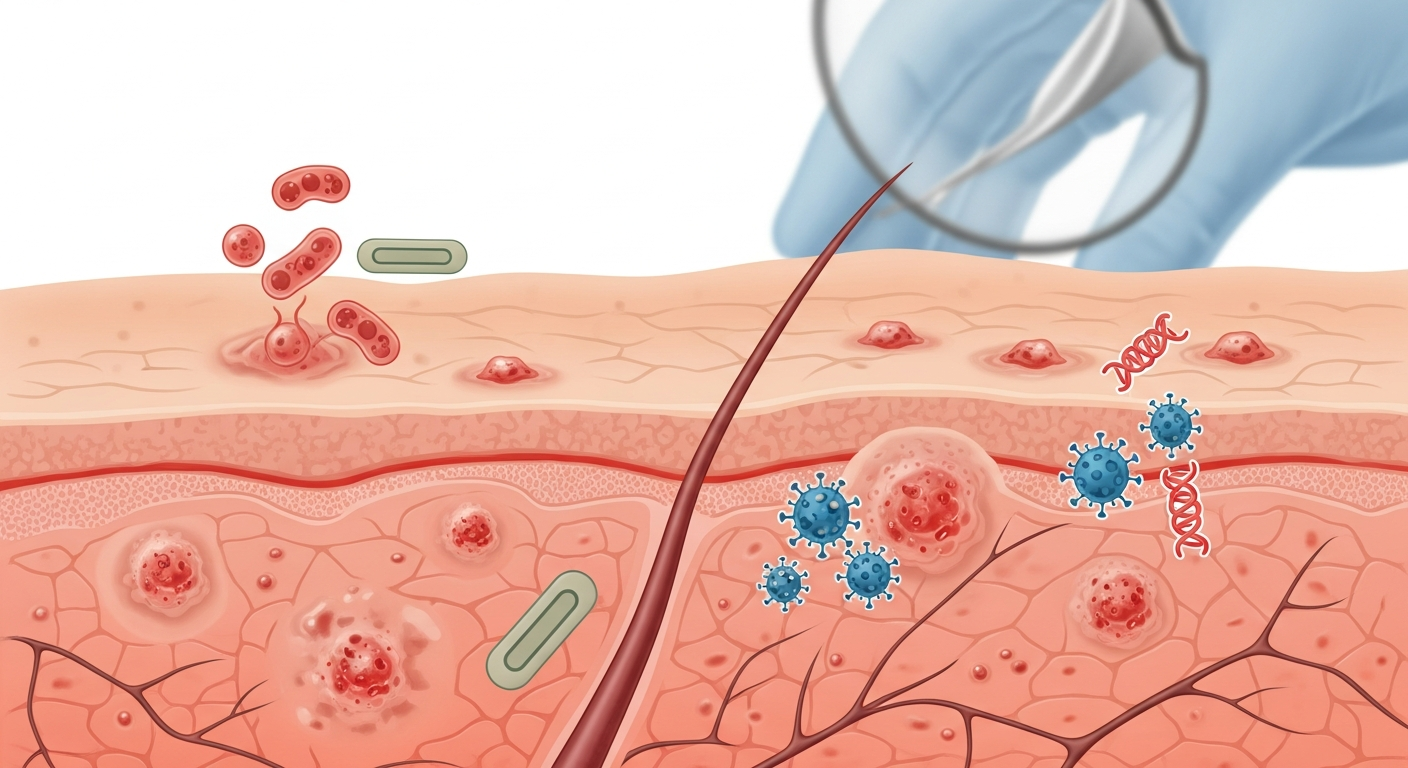
School-age children (ages 4–12) experience a distinct pattern of skin rashes driven by two major factors: school and social contact exposure to highly contagious infections, and the ongoing development of atopic conditions (eczema, allergies) as the immune system matures. Chickenpox (varicella), though declining in prevalence in vaccinated populations, remains a significant rash in unvaccinated children. Ringworm of the scalp (tinea capitis) is almost exclusively a condition of school-age children, spreading readily through shared hairbrushes, helmets, and head-to-head contact. Scabies — mite infestation — spreads through classrooms and households in clustered outbreaks. Hives (urticaria) from food allergies, medication reactions, or infection become increasingly common as children are exposed to a wider range of foods and drugs. Psoriasis can begin in childhood, often after a streptococcal throat infection triggering guttate psoriasis (droplet-shaped plaques). Atopic eczema, while peaking before age 5, persists and remains significant through the school years, substantially impacting sleep, concentration, and school performance. This guide covers the key rashes in school-age children, their contagiousness (critical for school exclusion decisions), distinguishing features, and treatment approaches.
Quick Medical Summary
Chickenpox, Ringworm, and Scabies in School-Age Children
Chickenpox (varicella) — in unvaccinated children — produces one of the most distinctive rashes in pediatrics: intensely itchy vesicles (blisters) in multiple stages simultaneously — macules (flat spots) progressing to papules (raised bumps) to vesicles ('dewdrop on a rose petal' appearance — a clear blister on a red base) to pustules to crusted sores, all present at the same time across the body. The rash begins on the trunk and scalp, then spreads to the face and extremities. New crops of lesions appear for 3–7 days. The child is contagious from 2 days before the rash until all lesions are fully crusted (typically 5–7 days). Manage with calamine lotion for itch, cool baths with colloidal oatmeal, antihistamines for sleep disruption, and antipyretics for fever. Antiviral therapy (aciclovir) is recommended for immunocompromised children, adolescents, adults, pregnant women, and children with severe disease. Ringworm of the scalp (tinea capitis) is almost exclusively a disease of pre-pubertal children. It causes scaly, sometimes inflamed patches on the scalp with associated hair loss (alopecia) — the fungi invade hair shafts, causing them to break at or near the scalp surface. Endothrix infection (Trichophyton tonsurans, common in African-Caribbean children) causes 'black dot' tinea capitis — hair stubs break off at the scalp surface, leaving dots in the patch. Ectothrix infection (Microsporum canis, from cats/dogs) fluoresces bright green under Wood's lamp. Oral antifungal treatment (griseofulvin or terbinafine for 6–8 weeks) is mandatory — topical antifungals cannot penetrate the hair follicle. Scabies in children spreads through prolonged skin contact and affects not just the wrists and finger webs (classic in adults) but also the scalp, face, palms, and soles — a distribution unusual in adults but typical in children. Permethrin 5% cream applied to the entire body (including the face and scalp in children) and washed off after 8–12 hours, repeated at 7 days, is the treatment of choice.
Eczema, Urticaria, and Guttate Psoriasis in School Children
Atopic eczema in school-age children concentrates on the flexural surfaces — inner elbows, back of knees, wrists, and ankles — and around the neck. The lichenification (skin thickening and hyperpigmentation) from chronic scratching is more pronounced in older children than in infants. School-related eczema triggers include chlorine in swimming pools, grass on sports fields, physical education sweat, and social anxiety exacerbating the itch-scratch cycle. Sleep disruption from nocturnal itching significantly impacts school performance and concentration — this is an often-underrecognized quality-of-life consequence that warrants escalation of treatment. Wet wrap therapy (applying emollient under wet cotton bandaging over eczema at night) is highly effective for controlling severe eczema in children and restoring sleep. Dupilumab (biologic) is now licensed from age 6 for moderate-to-severe atopic eczema. Urticaria (hives) in children is more commonly associated with viral infection (viral urticaria) than in adults — many cases of childhood hives appearing during or after a respiratory illness are immune reactions to the viral infection rather than drug allergy or food allergy. The classic post-viral urticaria requires only antihistamines for a few days and no allergy investigation. Food-triggered urticaria in school-age children most commonly involves peanuts, tree nuts, shellfish, and fish — these are the allergens for which epinephrine auto-injectors (EpiPens) should be prescribed for those with severe reactions. Guttate psoriasis — named for the raindrop-shaped (guttate) lesions — appears in children and adolescents 2–3 weeks after a streptococcal throat infection, producing hundreds of small (0.5–2cm), teardrop-shaped, lightly scaled pink plaques across the trunk, limbs, and face. It often resolves spontaneously within 3–4 months but may evolve into chronic plaque psoriasis.
Immune System Development in School-Age Children and Rash Patterns
The school-age immune system has made significant progress compared to toddlers: the Th2-skewed response of early childhood is gradually balanced by increasing Th1 activity as immunological memory accumulates from infections and vaccinations. This Th2-to-Th1 shift explains a clinically observable phenomenon — eczema tends to improve as children age through the primary school years, with approximately 50% of children who had eczema as infants experiencing significant improvement or remission by their teenage years. However, the same immunological shift occasionally reveals new conditions: guttate psoriasis triggered by streptococcal infections reflects the increasing Th17-mediated responses involved in psoriasis pathogenesis, which become more active as the immune system matures. School-age children develop increasingly sophisticated allergic sensitization — the combination of eczema, food allergy, asthma, and allergic rhinitis in the same child (the atopic march) peaks in severity during the school years. Adrenaline auto-injectors prescribed for severe food allergy should be reviewed annually and re-prescribed as the child grows to ensure the dose matches current body weight. School staff should be trained in recognizing and treating anaphylaxis in children with prescribed epinephrine. School exclusion guidance: children with impetigo can return 24 hours after starting antibiotics or when lesions are crusted. Children with chickenpox should stay home until all lesions are fully crusted (usually 5–7 days from rash onset). Children with scabies may return after first treatment is applied. Children with eczema, psoriasis, urticaria, and non-infectious rashes do not require exclusion.
When to See a Doctor and Prevention for School-Age Children
Seek emergency care for: non-blanching rash with fever (meningococcal), anaphylaxis (hives with throat swelling), and rapidly spreading redness with fever (cellulitis). See a doctor the same day for: widespread blistering or mucosal involvement after starting a new drug (SJS), unexplained high fever with rash not fitting a recognized pattern, scabies (requires prescription permethrin), and tinea capitis (requires prescription oral antifungal). Routine appointment within the week: eczema flare unresponsive to prescribed treatment, first episode of hives in a child, suspicious ringworm or impetigo, and recurring unexplained skin conditions. Prevention strategies: the MMR and varicella vaccines are the most impactful preventive measures against rash-causing infections in school-age children. Good hand hygiene prevents impetigo, HFMD, and molluscum spread. Discourage sharing of helmets, hairbrushes, and caps to prevent tinea capitis. Treat eczema proactively with daily emollient to maintain skin barrier and prevent secondary infections that complicate eczema. For children with food allergy, provide an anaphylaxis action plan to school staff and ensure an in-date epinephrine auto-injector is stored at school. Visit the rash symptoms guide for a detailed symptom-to-diagnosis matching tool, and the diagnosis guide for an overview of how skin conditions are formally evaluated and confirmed.
Key Symptoms
- Itchy blisters in all stages simultaneously on trunk and scalp (chickenpox)
- Scaly hair-loss patches on scalp (tinea capitis — requires oral antifungal)
- Intense itch in web spaces and wrists, worse at night (scabies)
- Lichenified, itchy rash in elbow/knee creases (eczema — school-age distribution)
- Widespread raised, itchy wheals migrating within 24 hours (urticaria/hives)
- Small teardrop-shaped lightly-scaled plaques on trunk after sore throat (guttate psoriasis)
- Honey-crusted sores around nose/mouth spreading in school setting (impetigo)
- Hives with throat swelling or breathing difficulty (anaphylaxis — emergency)
Treatment Options
- Chickenpox: calamine lotion; antihistamines; aciclovir for high-risk children
- Tinea capitis: oral griseofulvin or terbinafine for 6–8 weeks — topical insufficient
- Scabies: permethrin 5% to whole body including face/scalp; treat all contacts
- Eczema: daily emollient; topical steroid for flares; dupilumab for moderate-severe
- Urticaria: oral cetirizine or loratadine; epinephrine for anaphylaxis
- Guttate psoriasis: topical steroids; UVB phototherapy; watch for strep trigger
- Impetigo: topical mupirocin; oral antibiotics for widespread; exclude until treated
- Anaphylaxis: epinephrine auto-injector; call emergency services
| Condition | Cause | Contagious? | School Exclusion |
|---|---|---|---|
| Chickenpox | Varicella-zoster virus | Yes — highly | Until all lesions crusted (~5–7 days) |
| Impetigo | Staphylococcus/Streptococcus | Yes — highly | Until 24h after antibiotics started |
| Tinea Capitis | Dermatophyte fungus | Mildly | No exclusion with treatment started |
| Scabies | Sarcoptes scabiei mite | Yes — close contact | Until first treatment applied |
| Eczema | Inflammatory (non-infectious) | No | No exclusion required |
| Guttate Psoriasis | Immune response (non-infectious) | No | No exclusion required |
Further Reading by Age Group
When to See a Doctor Immediately
- Difficulty breathing or swallowing
- Swelling of the face, lips, or tongue
- High fever or severe chills
- Rapid spreading over a large body surface area
- Extreme pain, dizziness, or confusion
Frequently Asked Questions
Disclaimer
The medical information provided in this article is for educational purposes only and should not replace professional medical advice, diagnosis, or treatment. Always consult with a board-certified dermatologist or primary care physician regarding any severe or persistent skin conditions.